4 Point Probe: A Complete Guide to Its Principle, Correction Factor, and Real-World Uses
The 4 point probe is a widely used method for measuring the electrical properties of materials with a high level of accuracy. It is especially important in the study of semiconductors, thin films, conductive coatings, and modern electronic materials. In simple terms, this technique helps researchers, engineers, and manufacturers understand how easily electricity moves through a material.
What makes the 4 point probe so valuable is its ability to reduce errors that often appear in ordinary resistance measurements. When people use a basic two-point method, the contact between the probe and the sample can influence the final result. With a four-point setup, that problem is greatly reduced. This is why the method is trusted in both research labs and industrial environments.
Today, many people also search for related terms like 4 point probe 원리 and 4 point probe correction factor because they want to understand not only what the device does, but also how it works and why certain mathematical adjustments are needed. This article explains everything in a clear, natural, and informative way so that readers can understand the full importance of the 4 point probe.
Table of Contents
ToggleWhat Is a 4 Point Probe?
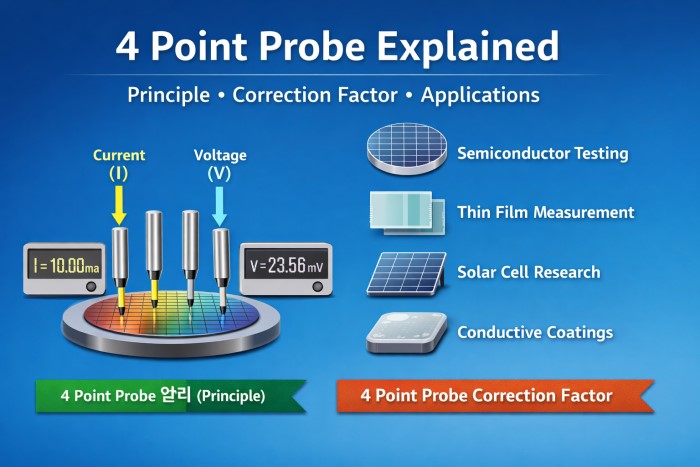
A 4 point probe is a measuring technique that uses four small metal probes placed in a straight line on the surface of a sample. Each probe has its own role. The two outer probes send electrical current through the material, while the two inner probes measure the voltage drop between them.
This design is very useful because it separates current injection from voltage measurement. In many other methods, the resistance of the probe contacts themselves can interfere with the reading. The 4 point probe avoids much of that problem, which leads to more reliable results.
This method is commonly used to measure sheet resistance in thin films and resistivity in thicker or bulk materials. Because these values are so important in electronics and material science, the 4 point probe has become a standard testing method around the world.
Why the 4 Point Probe Matters
Electrical performance is one of the most important qualities in many modern materials. A semiconductor wafer, a solar cell coating, or a transparent conductive film must often meet exact resistance requirements. If the resistance is too high or too low, the final product may not work as expected.
That is where the 4 point probe becomes essential. It gives a more dependable picture of a material’s electrical behavior. Instead of relying on a rough measurement, scientists and technicians can use this method to obtain data that is much closer to the true value.
Because of its precision, the technique is used in quality control, research, product development, and failure analysis. It is not just a laboratory tool. It is a practical method that supports real industrial decisions.
4 Point Probe 원리
The Basic Principle
The phrase 4 point probe 원리 refers to the working principle behind the four-point probe method. The idea is simple but very effective. A controlled current is passed through the two outer probes. As the current moves through the sample, a voltage difference develops across the surface. The two inner probes measure that voltage.
The measured voltage and applied current are then used to calculate the resistance of the material. Since the inner probes are only sensing voltage and not carrying large current, the effect of contact resistance is minimized. This is the main reason the method is considered more accurate than a standard two-point measurement.
Why the Principle Is Important
Understanding the principle helps explain why the four-point method is so widely respected. In many electronic materials, the true resistance value can be very small, and even a slight measurement error can lead to wrong conclusions. By separating current flow from voltage sensing, the 4 point probe 원리 provides a cleaner and more trustworthy reading.
This principle is especially helpful for thin materials where precision matters a great deal. In advanced electronics, a small inaccuracy may affect design choices, production settings, and overall product performance.
How a 4 Point Probe Measurement Works
Current and Voltage in the Test
The measurement process begins when the outer probes inject a known amount of current into the sample. That current spreads through the material and creates a voltage drop that reflects how strongly the material resists electrical flow. The inner probes measure this voltage drop.
The relationship between current and voltage is then used to determine sheet resistance or resistivity. Because the current and voltage paths are handled separately, the result is more accurate than many simple resistance tests.
Sheet Resistance
For thin, flat, and uniform materials, the result is often expressed as sheet resistance, usually written in ohms per square. This value is very important for thin films because it describes electrical behavior across the surface without needing to focus only on thickness.
Resistivity
If the thickness of the material is known, the sheet resistance can be converted into resistivity. Resistivity gives a broader understanding of how the material behaves electrically and is especially useful for bulk samples.
4 Point Probe Correction Factor
What It Means
The 4 point probe correction factor is an adjustment used when real test conditions differ from ideal assumptions. In theory, the standard equations work best when the sample is very large, uniform, and measured far from its edges. In practical situations, samples are often smaller, differently shaped, or limited in thickness.
These conditions affect how current flows through the material. As a result, the measured voltage may not perfectly match the ideal case. The correction factor is applied to improve the final result and make the resistance value more accurate.
When a Correction Factor Is Needed
A correction factor is commonly needed when the sample is small, when the probe is placed near the edge, when the material has noticeable thickness, or when the sample shape is not standard. In each of these cases, current distribution changes, and that can influence the reading.
This is why the 4 point probe correction factor is not just a mathematical detail. It is a practical part of serious measurement work. Without it, the final value may be misleading.
Why It Is Important
In semiconductor manufacturing and material research, even a small error can matter. A resistance value that seems slightly off might lead to incorrect quality judgments or poor design decisions. The correction factor helps reduce those risks and ensures that measurements reflect the real behavior of the material as closely as possible.
Common Applications of the 4 Point Probe
Semiconductor Testing
One of the most common applications of the 4 point probe is semiconductor wafer testing. It is used to evaluate the sheet resistance of doped silicon wafers and to check whether the wafer meets required electrical standards.
Thin Film Measurement
Thin films are used in many products, including sensors, displays, and electronic devices. The four-point method helps determine whether these films have the correct electrical performance.
Solar Cell Research
In solar technology, conductive layers play a major role in efficiency. The 4 point probe is often used to test these layers and support the development of better-performing solar cells.
Conductive Coatings
Metallic coatings and transparent conductive surfaces can also be tested with this method. Manufacturers rely on it when they need a quick and accurate way to assess conductivity.
Advantages of the 4 Point Probe
Better Accuracy
The biggest advantage of the 4 point probe is its higher accuracy compared with simple two-point resistance methods. By reducing the effect of contact resistance, it produces more dependable readings.
Useful for Many Materials
The technique works well for semiconductors, thin films, coatings, and other conductive materials. This wide usefulness makes it valuable in both science and industry.
Fast and Practical
Measurements can be made quickly, which is helpful in busy research labs and production lines. It offers a good balance of speed and precision.
Trusted in Industry
Because the method has been used for many years and is supported by strong theory, it is widely accepted as a reliable standard.
Limitations of the 4 Point Probe
Surface Condition Matters
The sample surface should be clean and reasonably smooth. Dust, damage, or roughness can affect the contact between probes and sample.
Complex Structures Can Be Difficult
If the material has multiple conductive layers, it may be harder to isolate the electrical behavior of just one layer. In such cases, interpretation becomes more challenging.
Corrections May Be Required
The technique is powerful, but it still depends on proper use. When conditions are not ideal, the 4 point probe correction factor becomes important for accurate results.
Quick Info About 4 Point Probe
Full Name
Four Point Probe Method
Main Purpose
To measure sheet resistance and resistivity of conductive materials
Common Fields
Semiconductor testing, thin film research, solar cell analysis, conductive coatings
Key Benefit
More accurate measurement by reducing contact resistance error
Related Search Terms
4 point probe 원리, 4 point probe correction factor
FAQs About 4 Point Probe
What is a 4 point probe used for?
A 4 point probe is used to measure the electrical resistance properties of materials, especially thin films, wafers, and conductive layers.
Why is the 4 point probe more accurate?
It is more accurate because the voltage measurement is separated from the current path, which reduces the effect of contact resistance.
What does 4 point probe 원리 mean?
It means the principle of the four-point probe method. It describes how current is applied through outer probes and voltage is measured through inner probes.
What is the 4 point probe correction factor?
It is an adjustment used to improve accuracy when the sample size, thickness, shape, or measurement position is not ideal.
Where is the 4 point probe commonly used?
It is commonly used in semiconductor manufacturing, materials science, electronics research, solar cell development, and conductive coating evaluation.
Conclusion
The 4 point probe is one of the most dependable methods for measuring electrical properties in modern materials. Its simple but smart design makes it far more accurate than ordinary resistance testing methods, especially when dealing with thin films and semiconductor surfaces. That is why it remains an essential tool in advanced research and industrial production.
By understanding the 4 point probe 원리, readers can see why this technique works so well. By learning about the 4 point probe correction factor, they can also understand how professionals improve accuracy in real testing conditions. Altogether, the 4 point probe is not just a scientific instrument. It is a practical and highly respected method that continues to play an important role in modern technology.